An AI calorie counter that shows its working
Photograph the meal or describe it in a sentence. You get the dish split into ingredients with calories, macros and a stated confidence level — all of it editable before anything is saved.
Analyse a picture, or just describe what you ate.
Per-item calories and macros, with a confidence note.
Adjust portions or overwrite the totals before saving.
A clearer download fit.
- You want the AI to do the tedious part, but you do not want to take its word as gospel.
- You eat food that is not in any database — home cooking, restaurant plates, half a friend’s dessert.
- You have tried an AI tracker that gave you one number and no way to see how it got there.
- You want the option to skip the photo entirely and just describe the meal.
Why this app earns the install.
The honest question before any download is what this does better than what you already have. Here is the answer, without the marketing detour.
It shows you the ingredients, not just a total
A photographed burger comes back as bun, patties, cheese and lettuce, each with its own calories, protein, carbs, fat and gram weight. If one line looks wrong, you fix that line rather than guessing at the whole figure.
It tells you how confident it is
Each analysis carries an explicit confidence level and the reason behind it — including whether it found a size reference such as a hand in the frame. An estimate that admits its uncertainty is more useful than one that does not.
No photo? Describe it instead
Type "2 slices of pepperoni pizza" and get the same treatment. Adding portion sizes, ingredients or how it was cooked sharpens the estimate. It is often faster than any database search.
Every number stays editable
Portions move with plus and minus, lines can be deleted, and the calorie and macro totals can simply be typed over. The AI produces a draft; you decide what actually gets saved.
The day on one screen, and everything behind it.
Six cards cover the day — calories, macros, weight, steps, fasting and water — and each opens into its own history. Underneath them, a single timeline holds the meals, drinks and weigh-ins you logged, in the order they happened.
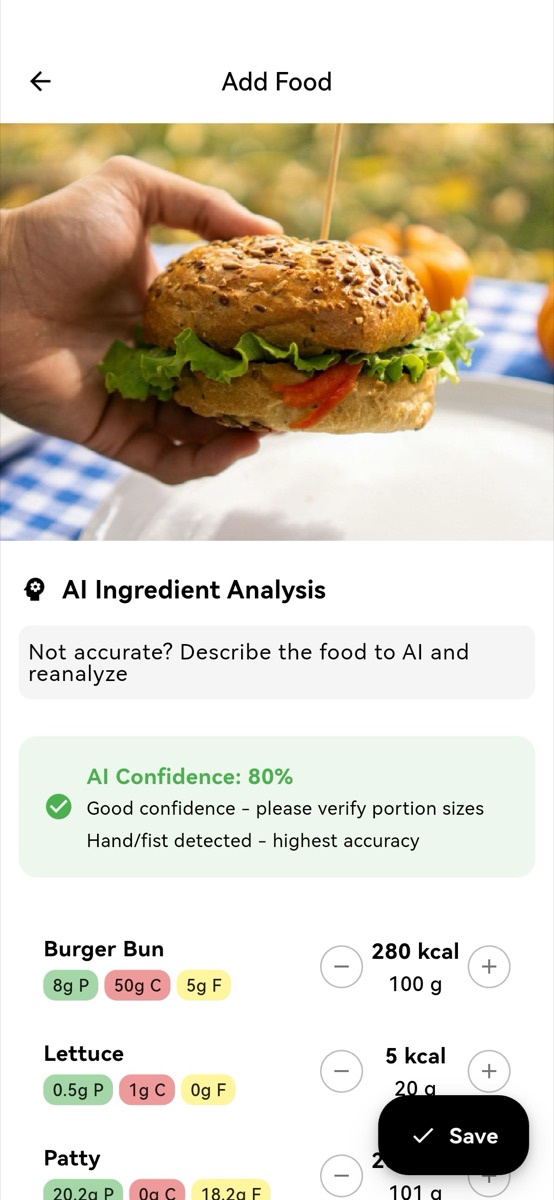
Photo logging with AI
Photograph the plate. The app returns the dish split into ingredients, each with calories and macros, plus a confidence note telling you how much to trust it. Every line is editable, and portions adjust with plus and minus.
- Ingredient breakdown
- Confidence shown
- Fully editable
Describe it in words
No photo to hand? Type "2 slices of pepperoni pizza" and get an estimate. Adding portion sizes and preparation details sharpens it.
- Plain language
- No search needed
Barcode scanning
Scan a packet and pull its nutrition from the Open Food Facts database. Results are cached on the device, so a product you have scanned before still resolves with no signal.
- Open Food Facts
- Cached offline
Favourites and manual entry
Save the meals you eat every week and re-log them in a tap, or type the numbers yourself when you already know them.
- One-tap re-log
- Manual totals
Three steps, still light.
Tracking only pays if it survives a bad week, so the daily loop is deliberately short.
Pick the right app angle.
No app suits everyone. Here is where this one fits, and where it does not.
Mixed plates, home cooking and restaurant meals are exactly where database search falls apart and a photo estimate earns its place.
For anything with a label, the built-in scanner pulls real nutrition data from Open Food Facts. Use the AI where guessing is genuinely required, not where the numbers already exist.
Portion sizes from a photograph carry real uncertainty, which is why the app states its confidence rather than hiding it. If you need gram-accurate figures, weigh the food and enter it manually — that path is here too.
Common questions.
How accurate is AI calorie counting?
Accurate enough to be useful, and honest about where it is not. The app reports a confidence level with every analysis, gives you the per-ingredient breakdown behind the total, and lets you correct anything before saving. A clear photo with a size reference such as your hand gives noticeably better portion estimates.
Do I have to take a photo?
No. You can describe the meal in plain language, scan a barcode, re-log a saved favourite, or type the numbers in yourself.
What happens to my food photos?
A meal photo is sent for analysis and discarded once the estimate returns. Only the nutrition data is kept, on your device. Body progress photos are handled differently again — they never leave your phone.
Does the AI work offline?
Analysing a new photo or description needs a connection. Everything else — browsing, editing, history, charts, and barcodes you have scanned before — works offline from on-device storage.
Is the AI feature behind a paywall?
No. Photo and description analysis are in the free app, with no per-scan limit to buy your way past.